EMPACTFUL PERSPECTIVES · VOL. 1: Chipping Away at Healthcare’s Consumerism Gap
By The Empactful Capital Team

Why patient activation and engagement have become table stakes rather than a differentiator, and how incumbents can begin to close the gap now
Key takeaways
|
|
|
|
The capability gap
American healthcare was engineered for administrative control rather than for the people at the center of it. Claims processing, eligibility checks, benefits administration, and risk adjustment were all built to manage money and move it accurately. The patient was largely left to navigate alone, receiving bills without context, owning no single source of truth about their own care, and lacking ready access to the data needed to make an informed decision. By IQVIA’s count, the roughly 300,000 health apps launched over the past fifteen years have digitized that problem rather than solved it.
The standard for what a “good” consumer experience feels like was not set by healthcare but by retail, banking, and hospitality. A consumer can book a flight, move money, or reorder groceries in minutes, yet still waits days for a lab result and weeks for an answer about what a procedure will cost. That gap between expectation and reality has become the defining consumer problem in healthcare, and consumers now carry those outside expectations into every interaction with a hospital or a health plan. Incumbents must now earn loyalty through tailored, relevant communication, or risk losing their most valuable patients to competitors who do.
The retailization of healthcare is already underway, and it has changed what activation and engagement must deliver. What once set an organization apart is now the price of staying in the game. The exhibits below suggest the gap between leaders and laggards is widening, not closing.
EXHIBIT 1
Patients are paying more out of pocket — the average single deductible has more than doubled since 2010
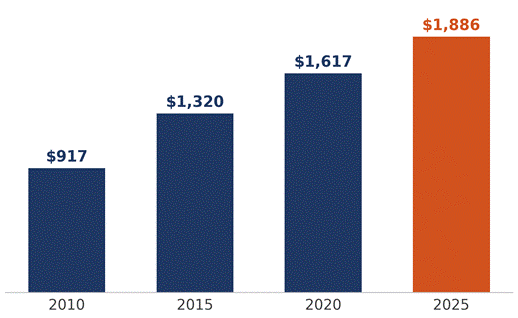
Average general annual deductible for single coverage among covered workers in a plan with a deductible. Source: KFF Employer Health Benefits Survey (2010 and 2025 surveys).
Why now: the economic case
Economics, not aspiration, is driving the shift, and the figures leave incumbents little room to treat activation and engagement as discretionary. Few recurring consumer decisions are as complex or as costly as healthcare.
Reimbursement pressure is structural and persistent. According to CMS projections, national healthcare spending will reach $8.6 trillion by 2033, growing faster than the broader economy, while the number of workers supporting each Medicare beneficiary continues to decline. The Business Group on Health reports that employers forecast a roughly 9% increase in healthcare costs for 2026, a second consecutive year of elevated trend, with total costs now more than 60% above 2017 levels. Unable to raise prices into relief, systems must instead retain more patients, especially the higher-margin, higher-lifetime-value relationships that fund the rest of the enterprise. Employers and the government, the largest payers, will keep shifting more of that burden onto consumers, raising the stakes for how deliberately incumbents manage these relationships.
EXHIBIT 2
Family premiums keep climbing — and workers are absorbing more of the bill
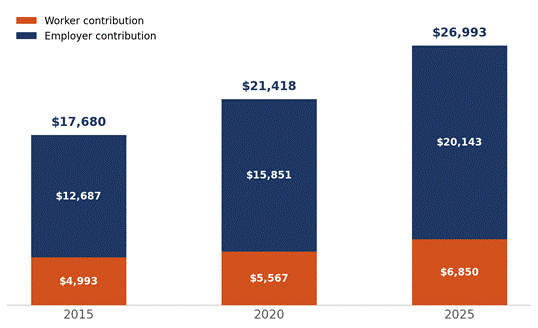
Average annual premium contributions for family coverage. Source: KFF Employer Health Benefits Survey, 2025 (Figure 1.1).
Retaining those relationships depends on earning loyalty, which requires reaching patients and members with a concrete reason to stay. The ground beneath incumbents is shifting in three respects at once. First, according to Optum, consumers are now the second-largest payer of healthcare, shouldering roughly 28% of total costs through high-deductible plans and rising out-of-pocket exposure, and they increasingly behave like the payers they have become. Second, federal and state price-transparency rules continue to expand, equipping consumers and employers with comparison data that did not exist a few years ago. Third, new entrants from retail, technology, and financial services are moving upstream through FSA and HSA dollars and patient financing, reshaping consumer expectations and competing directly for the relationship.
Consumers are also prepared to act on these shifts. According to Press Ganey and McKinsey, roughly 89% say they will shop for care in at least one category, 70% would leave their current provider, and 84% would reconsider a provider rated under four stars. The willingness to switch is well established; what is new is that the tools to act on it have caught up.
A financial divide is also widening beneath these dynamics. Recent executive research finds that roughly half of U.S. health systems describe their financial position as constrained, with many holding fewer than 180 days of cash on hand. Both constrained and well-positioned systems rank patient access and patient experience among their top priorities, but constrained systems cannot fund sweeping transformation and must instead, in the language of that research, “pick their spots” and partner selectively to strengthen their position. That constraint shapes much of what follows.
Taken together, these pressures point to a clear conclusion. Over the coming decade, every incumbent solution in healthcare will need to move toward a model that treats the patient or member as the end customer, one who must be actively engaged and served, and every technology partner serving these organizations will need to help enable that shift. For most organizations, the question is not whether to act but where to begin. The answer is rarely one big transformation, but the steady work of closing the gap one high-return use case at a time.
Practical applications across the portfolio
Empactful Capital’s investments were made with intention. Each portfolio company offers a platform that addresses a distinct part of the consumerism gap, and together they trace the arc of a single, lower-friction flow: a personalized message that reaches the right person, an interaction that keeps that person in-network, activation into the programs that improve their health, and the sustained engagement that retains them over time. None of these requires a wholesale transformation to begin, and each offers a defined and self-contained place to start.
Across our portfolio, a pattern emerges that the market consistently underprices. Engagement, navigation, and activation are usually sold as features bolted onto a clinical or administrative product, when in practice they function as the precondition for that product working at all. A care-management program without an activation layer does not merely underperform; it fails to enroll at all. A value-based contract without sustained engagement does not miss its target by a few points; it never reaches the patients who determine the result. The consistent lesson from our companies is that engagement operates as infrastructure rather than as a feature, determining whether the rest of the investment returns anything at all. Historically, even well-designed healthcare programs have engaged only a small fraction of the populations they target, which is exactly why a new, consumer-centric approach is needed.
Spotlight: Clutch Health
The point of view. Engagement tends to fail in healthcare for a straightforward reason: every patient or member receives broadly the same message, when a care-gap reminder, a benefit notification, and a complex behavior-change intervention in fact call for very different intensities. Effective engagement is therefore less a campaign than an exercise in orchestration across a continuum, matching the appropriate intervention to the right person at the right moment, much as the best retail and consumer businesses already do. Consumers readily signal how they prefer to be reached and what earns their loyalty, yet healthcare has largely failed to build those preferences into the member experience.
A genuinely distinctive offering. Clutch is the clearest expression of Empactful’s thesis on consumerism, and its platform is the product of deliberate assembly. Through the intentional acquisitions of Reciprocity Health and Perx Health, Clutch combined three capabilities that the market has historically offered only in pieces into a single behavioral orchestration platform. The first is behavioral intelligence: AI-driven micro-segmentation, predictive modeling, and hyper-personalized omnichannel journeys. The second is financial incentives: branded and white-label cards with real-time digital fulfillment, built on a CMS- and Medicaid-compliant framework and tied to behavioral triggers rather than offered as standalone rewards. The third is gamification: points, streaks, badges, and habit-forming loops that supply the daily feedback on which behavior change depends. No other platform in the market arms incumbent healthcare organizations with all three in an integrated form.
How it works. Clutch sits within a system’s existing infrastructure, threading through the organization’s data across clinical, claims, pharmacy, behavioral, and third-party signals and turning fragmented information into a unified member intelligence layer without requiring anything to be ripped out. The platform then matches intensity to population, ranging from low-intensity episodic outreach for a single care gap, to sustained engagement layered with financial incentives for chronic-condition management, to fully gamified daily engagement for the highest-risk and most complex members. Because it does not reset between campaigns, the platform learns from each interaction and compounds in value over time.
The practical application. There is little technical barrier to starting, because a partnership begins with a single use case and a single eligibility file — without IT tickets or a rip-and-replace effort — and delivers measurable value in days rather than months. From there the effect compounds, as each project broadens the intelligence across the population and integration deepens on the system’s own terms. The most rigorously tested results come from an independent, multi-year matched-control analysis — conducted by an external actuary across more than 3,600 psychiatric and musculoskeletal claims drawn from Clutch’s commercial-payer deployments — which found roughly 93% adherence to scheduled tasks and an 8x return on investment. Clutch’s own deployment data points in the same direction, with reported lifts such as a 5x increase in clinical program enrollment and email engagement several times the industry benchmark. In one national Medicare deployment, full-platform orchestration drove higher health-risk-assessment completion across a broader, pre-engaged population, and in a West Virginia Medicaid program for members managing Type 2 diabetes, engagement and incentives together produced a two-point A1c reduction over twelve weeks. In each case, the lift was achieved without disruption to existing operations.
For more on Clutch Health’s consumer loyalty and engagement platform: https://www.clutch.com/industries/healthcare
Spotlight: Care Continuity
Loyalty is often won or lost at the first interaction, and systems tend to lose visibility the moment a patient steps outside the EHR. As health systems adopt a lifetime-value mindset, they face growing pressure to deliver on the promise of operating as integrated, high-performing networks. Orchestrating a provider network into a seamless yet personalized patient experience, with coordinated outcomes and communication, is becoming an expectation rather than a differentiator. Care Continuity provides the cross-system patient matching and navigation that keeps patients in-network and helps them feel known and valued, guiding them through follow-up care recommendations, scheduling logistics, and provider-network alignment.
For more on Care Continuity’s platform: www.carecontinuity.com
Spotlight: ThoroughCare
Care management demonstrably works, yet only about 5% of eligible patients are ever enrolled. Activation sits at the top of the funnel for any care management and coordination program, under both traditional fee-for-service reimbursement and value-based-care economics, and without it even a well-designed clinical program will underperform. ThoroughCare applies AI-driven identification, prioritization, and enrollment to improve patient activation and capture validated savings per member. Given the central role activation plays in the care process, ThoroughCare is building a next-generation platform for physician organizations to engage their patients.
For more on ThoroughCare: www.thoroughcare.net/
Spotlight: Reema Health
In behavioral health, continuous engagement effectively is the business model. Financial and clinical outcomes depend largely on guiding the patient to the right care, in the right setting, at the right time. Reema Health works alongside patients to identify and address the unmet social needs that affect their mental and physical well-being. Its model illustrates how activation principles extend to one of healthcare’s hardest populations to serve: those who require tightly integrated physical and behavioral health because of their multiple, compounding conditions.
For more on Reema Health: www.reemahealth.com/
Pulling it together
Taken individually, each platform closes one part of the gap; taken together, they compose the seamless flow described earlier, from a first personalized outreach through in-network navigation, program activation, and sustained engagement. This is the consumer experience healthcare has largely lacked, and it can be built incrementally rather than through a single high-risk transformation.
EXHIBIT 3
Five steps to loyalty, powered by one orchestration layer
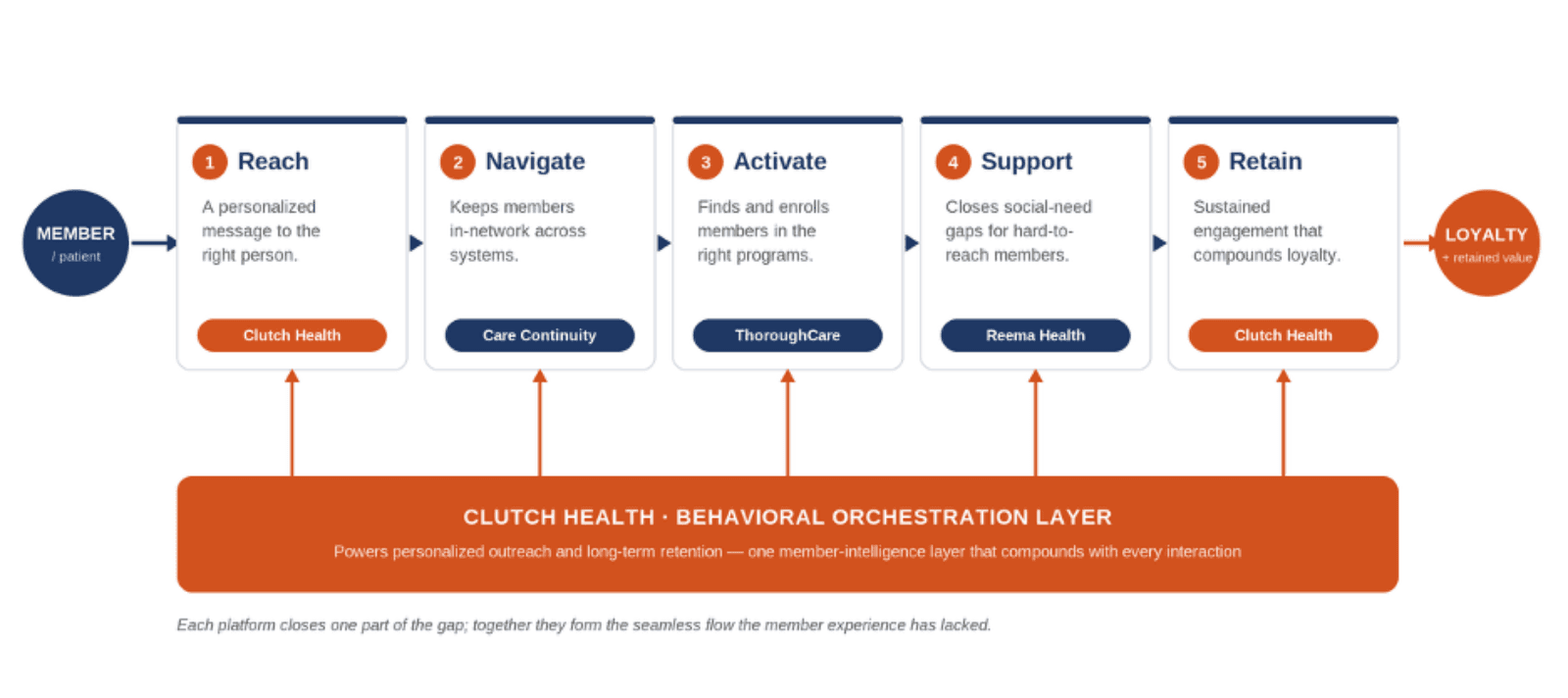
How Empactful’s portfolio composes a single member journey. Clutch Health orchestrates the flow and powers both the personalized outreach and long-term retention; Care Continuity keeps members in-network, ThoroughCare drives activation, and Reema Health closes the social-determinant gaps that make these populations hard to reach.
What this requires, however, is more than technology. Consumerism is at its core an evolution across people, process, technology, and business model, and that breadth is what makes executive leadership essential. Sequencing the right use cases, aligning incentives across a network, and connecting fragmented components into a coherent strategy is work done from the inside, alongside a system’s own leaders, rather than handed over as a set of recommendations. The organizations that succeed will build the internal capacity to sustain that work rather than treating it as a one-off purchase.
The common thread
Consumerism and activation are not ends in themselves but the foundation beneath the two shifts that will define the next era of healthcare: the move to value-based care models, and the full integration of physical and behavioral health. Each of these shifts depends on an engaged, activated patient, and each reflects, at its core, the premise of Whole Person Care, which we believe represents the future of healthcare and its largest pool of unrealized potential.
Organizations that begin to close the gap now, deliberately and incrementally, will build the loyalty and the underlying economics that fund what comes next. Those that wait will not simply miss an opportunity; they will keep losing ground to competitors who have already concluded that engagement is foundational rather than optional. With the gap well documented, the pressure to act rising, and the tools to respond now available, the relevant question for most incumbents is no longer whether to move, but where to start.
About Empactful Capital
Empactful Capital is a venture capital firm that specializes in early- and growth-stage healthcare opportunities, with a focus on whole-person care — including the technology that enables the shift to value-based models, the full integration of behavioral health, and healthcare consumerism. Established in 2016 by seasoned healthcare operators and investors, Empactful deploys targeted funds and leverages industry expertise to rapidly scale innovative companies. Through our pre-investment working engagement model, we identify areas of strength and development to ensure alignment and set a path to each company’s value creation and long-term success. Empactful is committed to transforming the healthcare industry through sustainable investments.
About Empactful Studios
Empactful Studios is a healthcare advisory firm that helps incumbents drive strategic transformation and develop their leaders, and helps early- and growth-stage businesses with strategy and company building. Rather than handing over slide decks full of recommendations, the team embeds alongside a company’s own leaders to accelerate strategy toward better outcomes, stronger margins, and greater capacity. Operating as a complementary partner to Empactful Capital, Empactful Studios also works with leading healthcare organizations and private equity firms pursuing growth, diversification, leadership development, and company-building initiatives.