
Why the forces reshaping primary care—a deepening physician shortage, a rising tide of chronic disease, and the steady migration from fee-for-service to value—point to a specific set of technology investments, and why the winners will serve both business models at once
Key takeaways
|
|
|
|
The forces reshaping primary care
Primary care sits at the center of the American health system and, increasingly, at the center of its strain. The specialty that is supposed to keep people healthy and out of the hospital is being asked to do more, for more people, with fewer hands. Three forces are converging at once, and each is accelerating the others.
The first is supply. The country is on track for a shortage of roughly 58,000 primary care physicians by 2040, as the existing workforce ages into retirement faster than it is replaced and fewer trainees choose primary care in the first place. The second is demography. By 2040, one in five Americans will be 65 or older, the age band that consumes primary care most intensively and presents with the most complex, overlapping conditions. The third is disease burden itself, which is rising faster than the clinical capacity available to meet it, across physicians, physician assistants, and nurse practitioners alike.
The result is a widening gap between what primary care is expected to deliver and what it is resourced to provide. Chronic disease is the clearest illustration: the share of American adults living with hypertension and diabetes has climbed sharply over two decades, and the trajectory shows no sign of flattening. Rising disease burden is meeting fewer resources, and the arithmetic does not resolve on its own. These physical conditions rarely travel alone: behavioral-health comorbidities such as depression, anxiety, and addiction frequently present alongside them in primary care, compounding the difficulty of managing either.
EXHIBIT 1
Rising disease burden: chronic conditions are climbing across the population
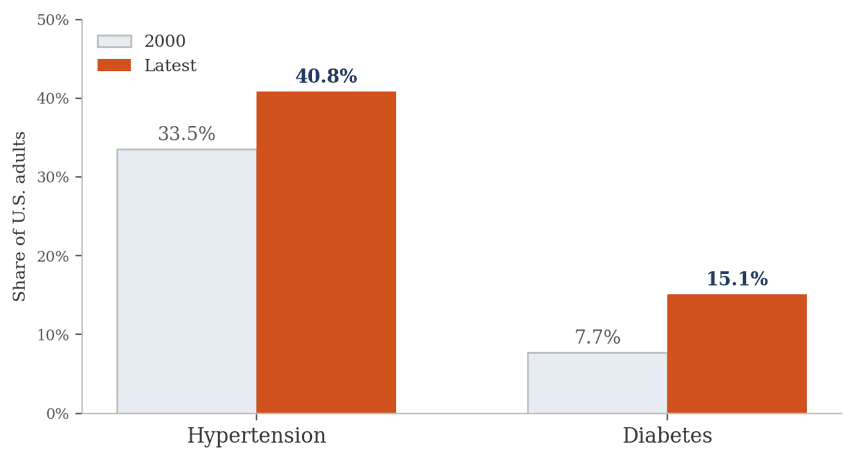
Share of U.S. adults with diagnosed hypertension and diabetes, 2000 versus most recent available. Hypertension figure reflects a projected 2020 estimate; diabetes reflects 2023. Sources compiled from CDC and public health surveillance data.
This is the backdrop against which the future of primary care is being reimagined. The most compelling version of that future does not ask physicians to simply see more patients in less time. It extends their reach. Daily, AI-assisted check-ins between patients and their care teams can turn chronic-disease management from a once-a-quarter visit into a continuous relationship, without a proportional increase in staff. For a patient managing type 2 diabetes, hypertension, and depression at once, that continuity is the difference between a slow decline and measurable improvement, and the economics follow the clinical gains: conservative estimates put the savings from this model at roughly $33,000 per patient per year for diabetes management alone. When care becomes continuous, the technology that enables it stops being a cost center and becomes the engine of better outcomes, patient engagement, and lower total cost.
The business model is changing beneath the visit
If the forces above describe the pressure on primary care, the payment model describes how that pressure will be resolved. The industry is in the middle of a slow but unmistakable migration from fee-for-service, which pays for volume, toward value-based and alternative payment models, which pay for outcomes, a transition the full integration of behavioral and physical health helps enable. The migration is far from complete, and that gap is precisely where the investment opportunity lies.
As of 2022, and even more so today, the payment mix is transitioning toward value-based and alternative payment models, as shown in Exhibit 2 below. Pure fee-for-service is shrinking, but it is not disappearing, and most practices now live in a blended world, drawing revenue from both systems at once.
EXHIBIT 2
The payment mix is shifting, but most practices still straddle both models
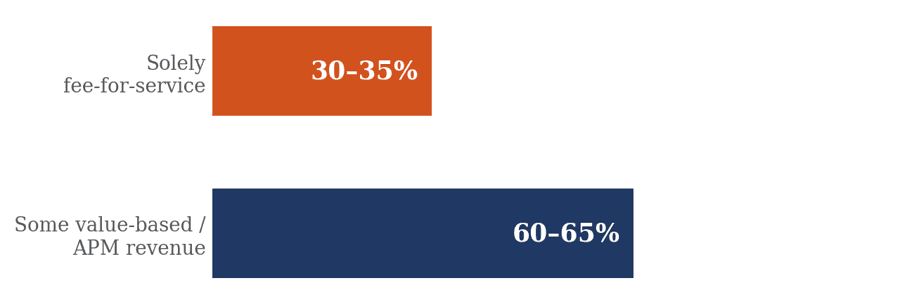
U.S. primary care practice payment mix, as of 2022. Categories are not mutually exclusive; most practices with value-based revenue also retain substantial fee-for-service income. Source: national payment-model measurement.
Three forces are pulling the market toward value. First, CMS has set a goal of having 100% of traditional Medicare beneficiaries in a value-based care relationship by 2030, a target that reshapes the largest single payer in primary care. Second, CMS models such as Making Care Primary are explicitly built on population-based payment, giving practices a concrete on-ramp to risk. Newer models push further still: CMS's ACCESS Model reimburses outcomes in Traditional Medicare across condition-based tracks spanning early and established cardio-kidney-metabolic disease, musculoskeletal pain, and behavioral health, and it is designed around the kind of technology-enabled, coordinated chronic-disease management described here. That its tracks now extend to depression and anxiety is a marker of how far the integration of behavioral and physical health has moved into mainstream payment. Third, major commercial payers are moving in the same direction, shifting their own contracts toward population-based structures. This shift is increasingly visible in CMS's own rulemaking: as Empactful Special Advisor Carrie Nixon has observed, the proposed CY 2027 Medicare Physician Fee Schedule moves to distinguish standalone technology from platforms that function as genuine care-delivery partners, and it includes formal requests for comment on AI-delivered primary care. The rule is only proposed (comments run through September 2026), but the direction of travel is unmistakable. At the opposite extreme, a smaller but fast-growing segment of practices is exiting insurance altogether: concierge and direct primary care models that take no insurance are rising rapidly, trading scale for simplicity and margin, a dynamic on vivid display in the rise of cash-pay prevention and longevity practices such as Atria, recently profiled in the Wall Street Journal.
The near-term destination is not full capitation but something in between. Hybrid models that blend some capitation with some fee-for-service will dominate the transition, rather than a wholesale leap to full risk. That matters for how technology is bought and sold, because the winning products cannot assume a practice lives purely in one world. The opportunity also cuts unevenly across payers. Because commercially insured members typically stay with a plan only two to three years, the long-horizon payoff of prevention rarely accrues to the payer that funded it, which is why full total-cost-of-care models have taken hold most firmly in Medicare, where patients remain attributed for far longer, and on the commercial side largely through self-insured employers. The value-based opportunity is strongest where patient tenure is long, and it should be weighted accordingly. And it raises the central challenge for the practices least able to adapt: small independent practices frequently lack the capital and infrastructure to embrace value-based care at all, which is what makes the next force, consolidation, both inevitable and investable.
Consolidation is accelerating
Value-based care rewards scale. Bearing risk requires the technology to track quality metrics, the data infrastructure to manage populations, and the working capital to absorb the volatility of shared-savings and capitated contracts. Independent practices, particularly small ones, rarely have all three. The predictable consequence is consolidation, and it has been underway for more than a decade.
Between 2012 and 2022, the share of physicians working in small practices fell sharply while the share in large practices rose, with mid-sized practices holding relatively stable. The drivers are consistent: independent practices lack the technology and analytics required to track value-based-payment quality metrics; escalating administrative, revenue-cycle, and revenue-integrity burdens, along with burnout and overhead, are pushing physicians toward the shelter of corporate employment; and practices are increasingly consolidating, both through physician-led vehicles such as IPAs, MSOs, and ACO aggregators and through acquisition by private equity, health systems, and insurers, each pursuing the primary care relationship for its own strategic reasons.
EXHIBIT 3
Physicians are moving out of small practices and into large ones
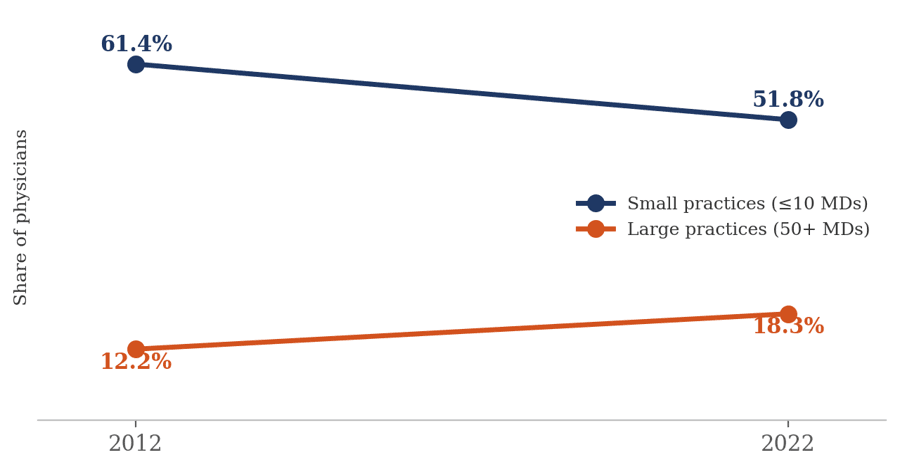
Share of U.S. physicians by practice size, 2012 versus 2022. Small practices are those with 10 or fewer physicians; large practices have 50 or more. Figures reflect all physicians rather than primary care specifically; the primary care trend runs in the same direction and, by most accounts, at least as fast. Source: AMA Physician Practice Benchmark Survey, 2012 and 2022 (physician share, all specialties).
Consolidation is not merely a structural curiosity; it reshapes who buys technology and what they buy. Larger, better-capitalized organizations can invest in the payment and technology models that value-based reimbursement demands, which means the center of gravity for purchasing decisions is shifting toward entities with the scale to deploy sophisticated tools and the attributed lives to justify them. Consolidation also begins to address a problem technology alone cannot solve: when a primary care practice, its specialists, and its downstream services sit inside one organization on a shared record, the data fragmentation that defeats coordination tools starts to resolve, giving those tools a coherent foundation to work from. For an investor, that shift is as important as the payment transition itself, because it determines the size, durability, and creditworthiness of the customer on the other side of the contract.
The right product for the right business model
The investment thesis follows directly from the two shifts above. Fee-for-service and value-based care are different businesses with different goals, and they reward fundamentally different software. A practice optimizing for fee-for-service is optimizing for volume, billing accuracy, reimbursement capture and integrity, and efficient scheduling. A practice bearing risk is optimizing for quality, utilization, and outcomes over volume. Technology built for one does not automatically serve the other, and the market has too often sold a single product into both. However, a new class of platforms is beginning to bridge the two, making these investments both practical and foundational.
Under fee-for-service, the highest-value tools attack administrative drag and revenue leakage: ambient documentation that captures the visit and drafts notes automatically, easing clerical burden; coding and clinical documentation support that improves accuracy and integrity, particularly for chronic disease and clinically complex patients; visit preparation that surfaces gaps in care, labs, and screenings before the patient arrives; revenue-cycle support that prevents billing errors and recaptures reimbursement that would otherwise leak away; and efficient and smart scheduling that books the right appointment at the right time, right location and right clinician with predictive intelligence that flags likely no-shows and prioritizes high-risk and high-cost scheduling for patients and practices.
Under value-based care, the priorities invert toward managing populations and improving outcomes while preventing avoidable costs through continuity of care. The highest-value tools include care-gap closure and predictive risk modeling that flags who is likely to be admitted or deteriorate; active care management and patient activation that keep patients engaged; disease-management prioritization that routes scarce nurse outreach to the patients who need it most; transitions-of-care support after an emergency-department or hospital discharge; and referral-leakage prevention and clinical-capacity orchestration that keep patients within a high-performing network. Prioritized care coordination extends the same logic to the social determinants (transportation, social-work coordination) that make it possible to fully integrate physical and behavioral health. Increasingly, agentic AI orchestration ties these functions together, with a single agent working across many of these tasks at once.
Agentic AI is the reason serving both models at once is finally realistic. Consider the primary care office of the near future, where an AI agent has been working overnight before the physician arrives: it has reviewed the day's schedule and flagged gaps in care, pre-ordered labs and started progress notes, triaged incoming calls and proactively booked follow-ups for chronic-disease patients, scanned local hospital records to see who was admitted or seen in the emergency department, and run risk-prediction models to flag the highest-risk patients and abnormal labs. Several of those tasks serve fee-for-service economics and several serve value-based economics, but they are performed by one orchestration layer. That vision assumes something most practices do not yet have: a unified view of the patient. In reality, data is scattered across disconnected systems: the practice’s own EMR, neighboring hospitals and emergency departments, specialty networks, and outside care-management vendors. That fragmentation is the single largest obstacle to the returns the technology promises. It is also the opportunity: the platforms that win will be those that resolve the underlying data fragmentation first, so that the orchestration layer has something coherent to act on. The coordination such a platform delivers is worth roughly $75,000 a year, which by our estimate is the fully loaded annual cost of a full-time care coordinator. The value, though, is not that a practice avoids the hire; in a market short of clinical hands, it is that the work gets done at all, and that the clinicians already on staff are freed from coordinator-grade tasks to practice at the top of their license. This is the shape of the durable investment: technology that pays for itself under today's fee-for-service reality while building the muscle that tomorrow's value-based contracts require.
Spotlight: ThoroughCare
One company in our portfolio sits precisely at the intersection of the two shifts described above, serving fee-for-service economics today while building the capabilities that value-based care rewards. ThoroughCare is the clearest expression of the thesis that the durable investments in primary care are those that work under both business models at once.
The point of view. Care management demonstrably works, yet only a small fraction of eligible patients are ever enrolled. Activation sits at the very top of the funnel for any care-management or coordination program, under both traditional fee-for-service reimbursement and value-based economics, and without it, even a well-designed clinical program will underperform. The problem is rarely the clinical model; it is that practices cannot reliably identify who is eligible, prioritize who to reach first, engage and enroll them efficiently, and then document, code, and bill the work correctly. Every patient left unenrolled is both a missed opportunity to improve an outcome and a missed opportunity to capture revenue the practice is entitled to. The mirror image of that problem is just as costly: as federal audits of care-management billing intensify, practices that document loosely, or bill for time they cannot substantiate, face clawbacks and penalties. Getting activation, documentation, and billing right is therefore not only a revenue-capture lever but a compliance one, what the market increasingly calls revenue integrity.
A platform built for both models. ThoroughCare applies AI-driven identification, prioritization, and enrollment to lift patient activation and capture validated savings per member, giving physician organizations a dual-purpose next-generation platform to engage their patients. That reflects a deliberate evolution from a care-management system of record (managing the patients a practice already knows are enrolled) toward population health management: taking the practice’s full panel, checking each patient against an ever-changing set of program-eligibility rules, and surfacing enrollment opportunities that neither the provider nor the patient may realize exist. It predicts and coordinates enrollment in the care-management programs that primary care increasingly depends on: chronic-care management, remote monitoring, behavioral health integration, and transitions of care. The platform also supports the documentation and coding that fee-for-service reimbursement requires while generating the quality and utilization data that value-based contracts reward. Threaded through both is agentified revenue integrity: the platform helps practices bill only for the work they can substantiate (neither leaving earned reimbursement uncaptured nor overreaching in ways an audit would penalize), and as scrutiny of care-management billing grows, ThoroughCare is increasingly packaging that capability as a standalone offering rather than a feature buried in the platform. That dual nature is the point: the same platform that helps a practice bill correctly under fee-for-service today builds the population-management muscle it will need as it takes on risk tomorrow. It is exactly the kind of segment worth betting on, one that earns its keep under current economics while positioning its customers for what comes next in payment models.
For more on ThoroughCare: www.thoroughcare.net/
Special considerations for investors
Two considerations deserve particular attention when underwriting opportunities in this market. The first is the local market environment. The pace at which value-based and risk-bearing arrangements can scale varies enormously by state, shaped by both regulation and the behavior of dominant payers, and that environment is increasingly enabling rather than constraining the shift. California's Knox-Keene Act, dating to 1975, laid the groundwork that allowed risk-bearing primary care and value-based care to scale across the state. Massachusetts’ shift came not through legislation but through a dominant payer: Blue Cross Blue Shield’s Alternative Quality Contract, launched in 2009, moved participating organizations away from fee-for-service, and because of the insurer’s market share, other payers followed. More recently, the same shift has reached Medicaid: a growing number of states, Mississippi among them, are moving their populations into managed, value-based arrangements that widen flexibility for hospitals and managed-care plans, mirroring at the state level CMS's drive toward value in Medicare. The direction of travel is consistent, but the timing and mechanics are local, and they materially affect which markets are ready for a given product today.
The second consideration is portfolio construction: the trade-off between average contract value and customer concentration. Selling into large, consolidated, value-based organizations promises high contract values and durable, creditworthy customers, but it concentrates revenue in a small number of powerful buyers. Selling into small independent practices diversifies the customer base but carries low contract values, higher acquisition costs, and greater churn. The right mix is not obvious. Consolidation is beginning to ease the tension, however: the growing ranks of large, multi-specialty groups make it possible to reach a high average contract value without leaning on a dangerously small set of customers. It remains one of the central strategic questions any investment in this space must answer deliberately rather than by default.
Where this leaves us
The through-line of this analysis is a market resolving its pressures in predictable directions: a deepening shortage of clinicians set against a rising tide of complex, often behaviorally comorbid chronic disease; a steady conversion from fee-for-service to value-based care in pursuit of better outcomes, patient centricity, and lower cost; and consolidation toward larger, better-capitalized practices with the scale to invest in new payment and technology models. The winning technology will serve both business models at once, and agentic AI is what finally makes serving both realistic.
What this requires, however, is more than any single tool. Serving both models at once is an orchestration problem that spans people, process, technology, and payment models, and that breadth is what makes leadership, not procurement, the deciding factor. Sequencing the right use cases, aligning incentives across a practice or network, and resolving the data fragmentation that defeats coordination is work done from the inside, alongside an organization's own leaders, rather than handed over as a set of recommendations. The organizations that succeed will build the internal capacity to sustain that work rather than treating it as a one-off purchase.
The common thread
The segments worth betting on are not ends in themselves but the foundation beneath the two shifts that will define the next era of primary care: the move to value-based payment, and the full integration of physical and behavioral health. Each of these shifts depends on an engaged, activated patient, and each reflects, at its core, the premise of Whole Person Care, which we believe represents the future of healthcare and its largest pool of unrealized potential.
Investors and operators who begin to close the gap now, deliberately and incrementally, will build the coordination capability and the underlying economics that fund what comes next. Those that wait will not simply miss an opportunity; they will cede ground to organizations that have already concluded that serving both business models, and engaging the activated patient beneath them, is foundational rather than optional. With the pressures well documented and the tools now available, the question for most is no longer whether to move, but where to start.
That is also where this series turns next. As primary care consolidates and takes on risk, the winners will not be individual practices but coordinated networks, and coordination at the network level is its own discipline. Orchestrating a provider network into a seamless, high-performing whole, with aligned incentives and a closed-loop system for retaining patients and members, is fast becoming the defining capability of the organizations that will lead value-based care. It is the subject we take up in our next Empactful Perspectives piece, and one the Empactful team looks forward to exploring with the entrepreneurs building toward it.
About Empactful Capital
Empactful Capital is a venture capital firm that specializes in early- and growth-stage healthcare opportunities, with a focus on whole-person care — including the technology that enables the shift to value-based models, the full integration of behavioral health, and healthcare consumerism. Established in 2016 by seasoned healthcare operators and investors, Empactful deploys targeted funds and leverages industry expertise to rapidly scale innovative companies. Through our pre-investment working engagement model, we identify areas of strength and development to ensure alignment and set a path to each company’s value creation and long-term success. Empactful is committed to transforming the healthcare industry through sustainable investments.
About Empactful Studios
Empactful Studios is a healthcare advisory firm that helps incumbents drive strategic transformation and develop their leaders, and helps early- and growth-stage businesses with strategy and company building. Rather than handing over slide decks full of recommendations, the team embeds alongside a company’s own leaders to accelerate strategy toward better outcomes, stronger margins, and greater capacity. Operating as a complementary partner to Empactful Capital, Empactful Studios also works with leading healthcare organizations and private equity firms pursuing growth, diversification, leadership development, and company-building initiatives.