
Why the next phase of value-based care will be decided at the network level rather than the practice level, as consolidation outpaces integration, as leakage begins to cost twice, and as a policy shock pushes health systems to manage populations they once wrote off, and why orchestration and closed-loop loyalty are becoming the same capability
Key takeaways
|
|
|
|
The network is the new unit of competition
Our last Perspective ended on consolidation: value-based care rewards scale, independent practices rarely have the capital or the data infrastructure to bear risk, and aggregation follows. Consolidation is a precondition rather than an answer, because bringing more physicians, sites, and services under one owner creates the possibility of coordinated care without necessarily producing it. A network today reaches well beyond employed physicians on a common record, and each addition improves the theoretical completeness of the network while adding a seam. A patient lost at a seam is lost as completely as one who never arrived.
“Health systems have spent years consolidating practices and providers, but consolidation only creates the possibility of integration. It may create payer leverage, but without the harder work of coordinating care across the network, it does not create a truly clinically integrated or high-performing system.”
— Jay Roszhart, MHA, FACHE, Former President and CEO, Springfield Memorial Hospital
The more useful way to read a network is by leverage rather than ownership, because the instruments available differ sharply by participant type. Over employed physicians a system holds the strongest lever, through employment agreements, compensation design, and direct governance. With clinically aligned partners it is moderate: co-management, shared incentives, and service line partnerships, often resting on handshake understandings that sit alongside the formal affiliation agreement rather than inside it. Over independent clinicians it is softest, consisting of referral relationships, trust, convenience, and goodwill. A fourth category differs in kind rather than degree: funded safety-net partners, meaning federally qualified health centers and rural health clinics, whose enhanced reimbursement is purpose-built for self-pay and Medicaid populations.
Two things follow. Leakage, clinical and financial alike, concentrates where the lever is softest, which is precisely where a system must earn the outcome rather than compel it. And even the strongest lever is weaker than it looks, since employing a physician means the referral can be placed inside the network but not that the patient goes. A system may employ almost no orthopedic surgeons in a market while depending on orthopedic volume at its own facilities, in which case the revenue rests entirely on partnerships it cannot direct.
EXHIBIT 1
One network, four different levers
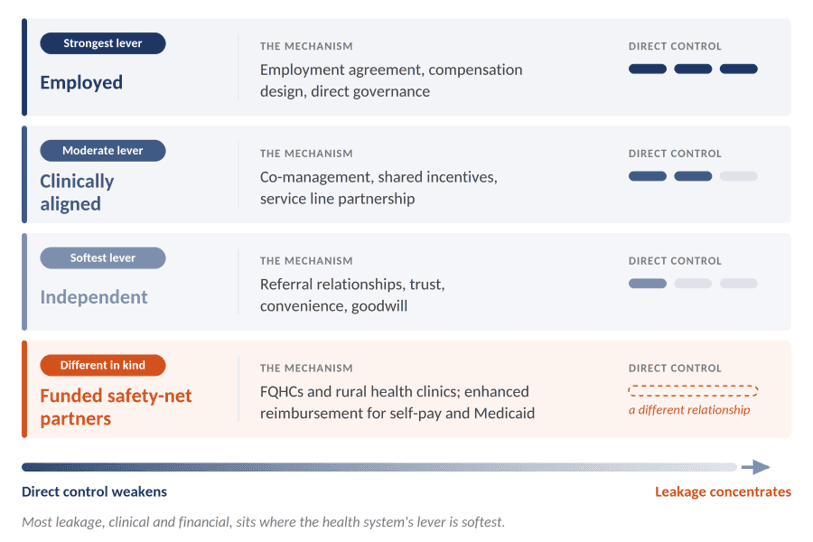
Participant types within a typical health system network, ordered by the strength of the instruments available to the system. Framework adapted from Care Continuity.
Two things the industry conflates are worth separating. Structural integration is a matter of contracts, ownership, branding, and a common instance of the medical record. Operational integration is the condition in which a patient reaches the right next appointment, with an appropriate clinician, at a suitable site, within a clinically sensible window, and the network knows that it happened. The first is what gets announced; the second is what payers increasingly pay for. The clearest evidence that the gap is real is how few systems can say whether the orchestration their partnerships describe is actually happening, and most do not have the data to know.
Why now: leakage costs twice
Leakage is not new, and its persistence has a straightforward explanation: under fee-for-service it has been a soft cost. A patient who receives a knee replacement across town represents forgone downstream revenue, but the loss is diffuse, hard to attribute to any particular referral decision, and easy to rationalize as patient choice.
Risk changes the character of the same event. When a network is accountable for the total cost of care for an attributed population, a patient treated outside it still counts against it. The care is delivered at a price the network did not negotiate, at a quality level it did not select, and it generates data the network will not see until a claim surfaces weeks later. The network therefore bears the cost, forgoes the margin, and is scored on an outcome it had no ability to observe. That is the doubling, and it is why network orchestration is moving from an operations concern to a board-level one.
Patients have become the enforcement mechanism. In Accenture’s research on provider switching, nearly 80% of patients who changed providers cited navigation-related factors as a reason for leaving. Roughly half as many cited clinical experience. That ordering inverts where most systems spend, because patients are not, for the most part, leaving over the medicine. They are leaving because nobody told them what happened next, which is the consumerism gap of our first Perspective arriving at the network level.
Experienced operators describe another capability emerging alongside navigation: recapture. Identifying that a patient intends to leave the network creates an opportunity to engage before the decision is final - explaining available in-network options, addressing access or convenience barriers, and helping the patient make an informed choice. Patient choice remains paramount, but choice does not require the network to remain passive.
The asymmetry makes it worse, because leakage is not randomly distributed but concentrates in the higher-acuity, higher-margin relationships that, as we argued in Vol. 1, fund the rest of the enterprise. The patient who needs a subspecialist quickly is the patient most likely to leave, and access has been moving in the wrong direction: by AMN Healthcare’s long-running survey, the average wait for a new patient physician appointment across 15 of the largest metropolitan areas reached 31 days in 2025, up 48% since 2004. A network whose internal access is worse than the market’s will systematically export its most valuable patients at the moments that matter most.
There is a quieter loss beneath the visible one, since a referral placed is not the same thing as a referral completed. In a national cohort of referred primary care patients, physicians reported that roughly one in five never resulted in a specialist visit within three months, and the published range across studies of outpatient specialty referrals runs from 30% to 50% never completed successfully. These patients are not lost to a competitor; they are never converted into care at all, so the network cannot even recognize the loss as competitive. Under fee-for-service this is invisible, while under risk it is a deferred liability, and the cardiology consult that never happened returns as an admission.
EXHIBIT 2
A large share of referrals never becomes care, and the share widens with patient complexity
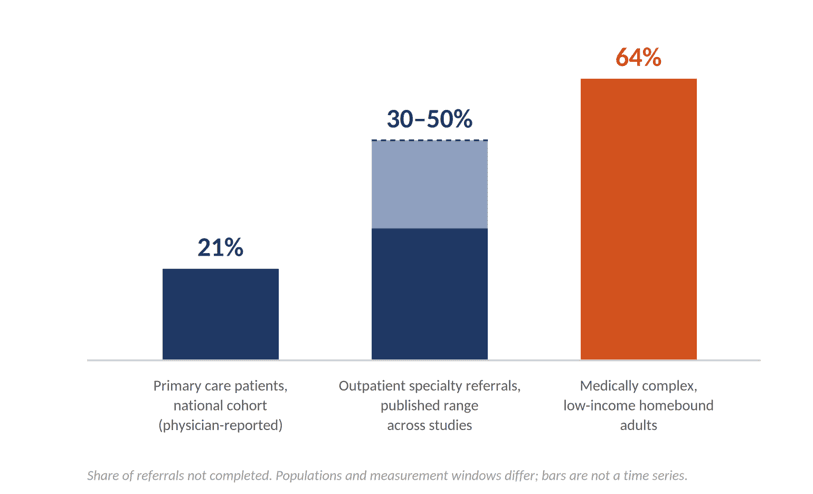
Share of specialty referrals not completed. Populations, definitions, and measurement windows differ across the three figures, so they are not directly comparable and are not a time series. Sources: Forrest et al., Annals of Family Medicine (2007); published literature on cross-institutional referral loop closure; Duke Just for Us program analysis.
The Medicaid shock and the retention horizon
A second force arrived more recently and is now the one health system leaders raise first. Federal Medicaid spending is set to fall by more than $1 trillion over ten years under the budget reconciliation law enacted in July 2025, through work requirements taking effect in 2027, more frequent eligibility redeterminations, and restrictions on state provider taxes. Analyses from the Congressional Budget Office and RAND put coverage loss between roughly 7.6 and 14 million people over the coming decade, and uncompensated care has historically tracked the uninsured rate closely and with little lag.
The chain of consequences is easy to trace. A patient who loses coverage becomes self-pay and financially at risk, and without navigation that patient’s care is deferred until it is urgent, presents in the emergency department, and becomes uncompensated. With an aligned network, the same patient is routed to primary care or to a funded partner such as a federally qualified health center, where the reimbursement structure was designed for exactly this population. The difference between those two paths is not clinical capability but whether anyone routed the patient at all.
Underneath that sits a point we raised in Vol. 2 and now want to revise. We noted there that the returns to prevention and retention are hardest to capture in commercially insured populations, because a member who changes coverage in two or three years takes the benefit of the investment with them, and that Medicare accordingly offers cleaner economics. The Medicaid and self-pay populations complicate that framing usefully, because they are among the least mobile people a health system serves. For non-profit systems, this population overlaps heavily with the mandate behind community-benefit spending, which is a funding source already earmarked for exactly this kind of outreach. The per-encounter economics are poor, but the attribution horizon is long, and that is what determines whether an investment in retention has time to pay back. A population treated as economically unrecoverable turns out to be one of the few where the arithmetic of prevention actually closes.
Orchestration is a discipline, not a directory
If leakage is the symptom, the underlying condition is that most networks have bought referral infrastructure rather than orchestration capability. The distinction shows up as three recurring failure modes.
The static directory. Most referral tooling answers who is in the network, when the operative question is harder: who can see this patient soonest, at an appropriate site, at a quality tier the network will stand behind? Orchestration has to answer that in the seconds while the patient is still in front of someone, because anything slower converts the referral into a to-do item, and to-do items leak.
The visibility gap. As we noted in Vol. 1, systems lose sight of the patient the moment that patient steps outside the electronic record. Transitions of care are among the highest-acuity moments in a patient’s year and occur exactly where the network’s information is thinnest.
Incentive misalignment. Asking an affiliated independent specialist to route inside a network that competes with them for the same patients is a governance question rather than a software one. Where the incentive is misaligned no orchestration layer will overcome it, and where it is aligned orchestration is what makes the alignment operational rather than aspirational.
The obvious question is why the systems already in place do not solve this. Electronic health records are optimized for documentation, coding, and billing; one health system executive’s summary of the dominant record was that it is the best cash register on the market. Orders and referrals, similarly, are administrative proxies, and much of what ought to become care never takes the form of an order at all. Care Continuity’s experience is that roughly 80% of the procedures it routes back into a health system began not in a formal referral but in a clinician’s note, an emergency physician suggesting follow-up with cardiology and moving on. Nor can the record be relied upon at the other end, since a referral is commonly marked complete once a call center has sent a text or left a voicemail, which records that the organization made an attempt rather than that the patient received care.
Digital scheduling deserves particular attention, because it is the investment most often mistaken for a fix. Self-directed scheduling solves convenience, and solves it for the patients who least needed help: fewer than 25% of patients self-schedule at the majority of practices by the Medical Group Management Association’s count, and work published in the Journal of the American Medical Informatics Association puts the share of self-scheduled appointments actually kept at 59%. What none of these tools do, including the most automated, is rank one patient against another. They operate first in, first out, so the sickest patient in the queue is scheduled behind whoever happened to call-in for an appointment before them, which leaves call order rather than clinical need to decide who is seen first.
Those failure modes also let us define the term in this Perspective’s title. A high-performance network is not a narrow network. Narrowness is a contracting construct that reduces the number of participants and negotiates harder with those who remain, while high performance is a management construct, in which participants are selected, monitored, and continuously re-ranked on measured access, quality, cost, and referral completion. The measurement loop is what makes the network high-performing, and a narrow network without it is simply a smaller network that will underperform for the same reasons.
The closed loop
The capability that resolves all of this is a loop, and it is worth stating its steps plainly, because almost every network in the country executes the first two and stops.
The loop begins when the network identifies that something warrants a next step. It then routes that patient, which is the orchestration decision described above. The third step is to confirm, and it is the one almost universally missing: was the appointment actually made, actually kept, and actually documented? Confirmation is what converts intent into care, and its absence is why so many well-designed referral programs report activity rather than results. The fourth is to measure the outcome, the cost, the patient’s own account of the experience, and whether the destination performed the way the network expected. The fifth is to feed back, and the result returns to two places at once.
“Closing the loop means measuring what actually happened, not whether the referral was administratively marked complete. We looked at time to schedule, time to appointment, whether the appointment was kept, downstream utilization, outcomes and patient experience - and used that information to improve the next referral decision.”
— Jay Roszhart, MHA, FACHE, Former President and CEO, Springfield Memorial Hospital
That last step is where the argument of this Perspective lives. The two destinations are the next routing decision, which is network performance management, and the ongoing relationship with the person, which is loyalty. In practically every organization we encounter those two are owned by different functions, funded from different budgets, and served by different vendors. They are not two loops, but one loop cut in half by the org chart, and that cut is why it stays open.
EXHIBIT 3
The closed loop: five steps, one system
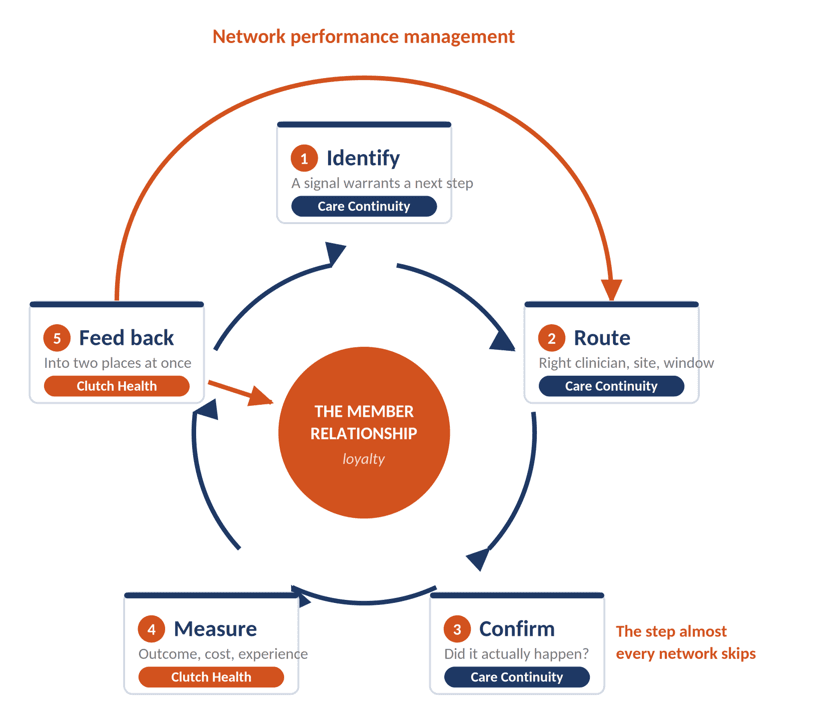
How network orchestration and patient loyalty resolve into a single cycle, with the feedback returning to both the routing engine and the member relationship. Compare the five-step loyalty sequence in Vol. 1.
The consequences run in both directions. A routing engine that never learns what happened degrades into the directory it was bought to replace, while an engagement program that does not know what happened clinically has no choice but to send generic messages, which is exactly the failure we diagnosed in Vol. 1. Orchestration without engagement is a routing engine patients ignore, and engagement without orchestration is a well-crafted message with nowhere specific to send anyone. Closed the other way, the loop compounds, and it is unusually difficult for a competitor to replicate, since the asset is the accumulated record of what actually happened to a specific population inside a specific network.
Spotlight: Care Continuity
One company in our portfolio was built specifically for the seams described above, and it is the clearest expression of our view that network performance is won at the handoff.
The point of view. Health systems have invested extraordinary sums in the medical record and in access, while comparatively little has gone into the connective tissue between them. As systems adopt a lifetime-value mindset, the pressure to operate as a genuinely integrated network is no longer merely reputational; it has become contractual.
A genuinely distinctive offering. Care Continuity provides the cross-system patient matching and navigation that keeps patients in-network. What distinguishes it is identity resolution across organizational boundaries: recognizing that the patient who appeared in an outside facility is the same person the network is accountable for, and doing so quickly enough to act on it rather than merely to record it. That is the visibility gap addressed directly, and it is what allows the first two steps of the loop to operate on events the network would otherwise never see.
How it works. The platform sits across the four participant types in Exhibit 1 and helps navigate patients to all four participant types. While it adds value to the system across all four, the perceived value is generally with the middle two, since systems tend to discount navigation for employed physicians and to attribute the greatest incremental value to the clinically aligned and preferred independent relationships, where they hold no direct authority and the volume is genuinely at stake. Care Continuity detects the event, resolves the patient’s identity against the network’s own population, and carries the handoff far enough to establish whether it actually happened. The platform predicts each patients’ likelihood of a severe event, potential need for downstream procedures, no-show risk, and modality of communication type for best chance of success. The predictions do not incorporate payer to ensure patients are treated based on needs, but payer comes into play for VBC contracts. Most of their Health System customers have recently added focused navigation for their self-pay and Medicaid patients leaving the inpatient setting. Supporting the Medicaid Shock in the section above: sophisticated systems are realizing this population, by default, is a value based population that they need to make healthier and help reduce future cost pressures. The same mechanism in the Care Continuity platform can help route patients to funded partners and primary care rather than allowing the emergency department to become the default.
The practical application. What has proved as valuable as the navigation is the data it generates. A system that can see where procedures are actually happening, who is performing them, and which downstream clinicians produce fewer adverse secondary events can answer questions it previously guessed at. Analytics that inform decisions of that kind are harder to displace than workflow software, and the most useful evidence on returns is revealed rather than reported: the company’s largest customers have re-tested the economics repeatedly over several years and have answered each time by widening the deployment rather than narrowing it.
For more on Care Continuity’s platform: www.carecontinuity.com
Spotlight: Clutch Health
If Care Continuity closes the loop around the referral, Clutch Health closes it around the person. As we described in Vol. 1, Clutch combines three capabilities the market has historically offered only in pieces: behavioral intelligence that segments and predicts; financial incentives delivered through compliant card infrastructure; and gamification that supplies the daily feedback on which sustained behavior change depends. A routing decision only becomes care if the person acts on it, and people act on communication that reflects what they have already done and how they prefer to be reached.
Many systems have tried to close this gap with telephonic outreach to high-risk patients, an approach that is labor-intensive, costly, and difficult to sustain at the scale a network-wide loop requires. This combination of network orchestration and patient engagement matters most in exactly the population the policy shock has made most urgent to retain. Self-pay and Medicaid patients are the hardest to reach through conventional outreach, and they are the most likely to default to the emergency department when a next step is unclear. It is also the half of the loop that converts measurement into retention, since a network that has learned what happened has no way to act on that knowledge except through the person. A network-integrity program without an engagement layer does not merely underperform its leakage target, it fails to change patient behavior at all, because nothing in it ever reaches the patient in a form they respond to.
For more on Clutch Health’s consumer loyalty and engagement platform: www.clutch.com/industries/healthcare
The operating model this requires
Everything described so far can be bought. What cannot be bought is the condition under which any of it works, and that condition is an operating model rather than a procurement decision.
Incentive design is the clearest case, because it is the mechanism by which a soft lever is made stronger. Employment agreements settle the question for employed physicians and do nothing for anyone else, which leaves most of the network in Exhibit 1 governed by relationships rather than instruments. The systems that have solved this have generally solved it through funds flow. One approach we have seen work is to negotiate value-based contracts deliberately structured to create an embedded surplus, accepting a lower headline rate in exchange for a pool of money the system controls, and then distributing that pool across the whole clinically integrated network rather than to employed physicians alone. The surplus becomes the instrument the affiliation agreement never provided, and it requires contract structures designed from the outset with that purpose in mind.
The same point explains a governance fight that recurs more often than is reported, which is the question of who holds signatory authority over contracts. Where the physician enterprise and the hospital enterprise each believe the pen belongs to them, the underlying disagreement is rarely procedural. It is a disagreement about which value lever the organization is orchestrating around. Two further conditions are equally unbuyable: data rights across participants, negotiated between network members rather than configured in an application, and a single agreed definition of network performance with a named owner, without which the organization will spend its first two quarters arguing about the denominator instead of improving the number.
Decisions of that kind are taken inside an organization, by people accountable for the result. They are served by working alongside an organization’s own leaders until the capability is theirs, which is the model Empactful Studios was built to deliver and the reason we treat the loop as a leadership undertaking rather than a purchase.
One thesis, many markets
A caution belongs here, and it is large enough that we will return to it properly. The argument above has been made as though every network faced the same incentives, and they do not. Most health systems in the United States, whatever they say about their trajectory, still make decisions on fee-for-service terms, and where value-based arrangements are upside-only or a minority of the book they do not drive the choices that matter. That distinction is becoming less binary: for some systems, Medicare can already be a negative-margin book of business, making utilization financially consequential even before formal downside-risk arrangements dominate the portfolio. In those markets network integrity is not a value-based-care initiative at all; it is how the core business is defended. In genuinely mature risk markets, Massachusetts and much of California among them, the same arithmetic inverts. A care management program billed under fee-for-service codes stops being incremental revenue and becomes an expense inside the risk deal, adjudicating against the risk pool and leaving less funds flow for the population health entity that would otherwise have used it to influence behavior across the network. The product has not changed at all. Where a buyer sits on that journey determines how much the same capability is worth to them, which is why the ideal customer profile of any company in this category has to be tested against where its markets actually sit rather than against where the industry says it is heading.
Special considerations for investors
Two considerations deserve particular attention when underwriting in this category. The first is buyer fragmentation, which is underestimated more often than any technical risk. Network integrity, patient access, marketing, and population health typically hold separate budgets, separate mandates, and separate definitions of success, so a product built to serve the closed loop as a whole can arrive in front of four executives none of whom is authorized to buy it. The symptom is a pipeline full of enthusiastic champions and unexplained slow conversion, and while it is a go-to-market problem rather than a product one, it has ended more companies in this category than any shortfall in capability. The businesses that navigate it tend to enter through a single budget with a narrow, measurable use case, and to expand once the data is difficult to argue with, rather than selling the whole loop on the first call.
Budget fragmentation is only one source of friction. Technology governance and legal and compliance review can create equally consequential delays, particularly when a product touches patient data, referral patterns, or workflows that span multiple enterprises.
The second is population tenure, which we would now substitute for the payer-mix heuristic we used in Vol. 2. What determines whether retention and prevention pay back is not whether a population is commercial, Medicare, or Medicaid, but how long that population stays. Commercially insured members typically remain with a plan two to three years, which is rarely long enough for the investment to return; Medicare, Medicaid, and self-pay populations tend to stay put, which is why the economics can work there even where per-encounter reimbursement is poor. A network orchestration business should therefore be underwritten against the tenure of the populations its customers actually serve, and against the duration of the contracts through which those customers are paid, rather than against the payer label on the front of the book.
Where this leaves us
This is a market whose structure has changed faster than its operations. Consolidation assembled the networks; risk made their performance measurable and consequential; policy removed the option of ignoring the populations that leak most; and patients, now the second-largest payer of healthcare, have begun making each referral decision the way they make other consumer decisions. Those developments converge on a single capability: the ability to route a patient well and then find out what happened, repeatedly, at scale, in a way that improves both the network and the relationship. Closing that loop spans people, process, technology, governance, and payment model, and that breadth is what makes leadership rather than procurement the deciding factor. Orchestration and loyalty have been pursued as separate programs when they are in fact a single loop, and the organizations that build the capacity to close it will own the economics of the next decade of value-based care.
The common thread
Network orchestration and closed-loop loyalty are not ends in themselves but the foundation beneath the two shifts that will define the next era of healthcare: the move to value-based payment, and the full integration of physical and behavioral health. Each reflects, at its core, the premise of Whole Person Care, which we believe represents the future of healthcare and its largest pool of unrealized potential.
That model also depends on patient engagement and activation. People must know what to do, where and when to do it, have the means and willingness to act, and remain able to follow through even under stress. In that sense, engagement is not a communications layer added to Whole Person Care; it is one of the competencies that makes coordinated care executable.
Organizations that begin to close the loop now, deliberately and incrementally, will build the coordination capability and the underlying economics that fund what comes next. With the pressures well documented and the tools now available, the question for most is no longer whether to move, but where to start.
Where to start, though, depends on where a market already is, and the answer differs far more than the industry’s shared vocabulary suggests. The path from fee-for-service to value is circuitous and specific to each market, and the contracting structures, funds flow mechanics, and payer dynamics that determine what a network can actually do are the subject we take up in our next Empactful Perspective, and one the Empactful team looks forward to exploring with the operators and entrepreneurs working through it.
About Empactful Capital
Empactful Capital is a venture capital firm that specializes in early- and growth-stage healthcare opportunities, with a focus on whole-person care — including the technology that enables the shift to value-based models, the full integration of behavioral health, and healthcare consumerism. Established in 2016 by seasoned healthcare operators and investors, Empactful deploys targeted funds and leverages industry expertise to rapidly scale innovative companies. Through our pre-investment working engagement model, we identify areas of strength and development to ensure alignment and set a path to each company’s value creation and long-term success. Empactful is committed to transforming the healthcare industry through sustainable investments.
About Empactful Studios
Empactful Studios is a healthcare advisory firm that helps incumbents drive strategic transformation and develop their leaders, and helps early- and growth-stage businesses with strategy and company building. Rather than handing over slide decks full of recommendations, the team embeds alongside a company’s own leaders to accelerate strategy toward better outcomes, stronger margins, and greater capacity. Operating as a complementary partner to Empactful Capital, Empactful Studios also works with leading healthcare organizations and private equity firms pursuing growth, diversification, leadership development, and company-building initiatives.